Nov 26, 2026
ASUS AI Orchestrator: One Enterprise AI Platform from GPU Allocation to Token Metering
A GPU sits idle while a training job waits in the queue. An API key quietly burns through tokens nobody budgeted for. Finance asks who owns the bill, and three different systems give three different answers. For many enterprises, the hardest part of AI is no longer building the model; it is running AI reliably, securely and at a cost the business can explain.
As an end-to-end AI infrastructure solution provider, ASUS reinforced its unified AI infrastructure platform spanning accelerated computing, networking, storage, deployment software, AI operations and governance. By integrating infrastructure engineering, deployment and operational intelligence into a continuous platform, ASUS helps organizations shorten time to first token, accelerate time to revenue and optimize infrastructure efficiency while maintaining trusted AI at scale. The latest AI software platform, the “AI Orchestrator”, brings GPU allocation, training, deployment, API access and cost tracking onto one platform. ASUS backs it with complete services, from sizing and deployment to onboarding and ongoing technical support, so teams get one accountable partner instead of a patchwork of vendors.
What Is ASUS AI Orchestrator?
ASUS AI Orchestrator is an enterprise AI orchestration platform that manages the full AI lifecycle in one place: GPU allocation, model development and training, deployment, API access and per-call token metering. It is built for IT leaders, AI platform teams and developers who need to move AI from pilot to production without stitching together a different tool for every step.

Why Fragmented AI Stacks Slow Enterprises Down
Once AI reaches production, development environments, training jobs, model deployment, API access and cost allocation usually live in separate systems run by separate teams. The result is stalled jobs, unclear ownership of GPU spend and no single view of usage. ASUS AI Orchestrator brings these functions under one entry point: developers build, train and deploy from the same interface, while administrators track quotas, usage and cost in the same place.
Build and Train: Shared GPUs and Automated MLOps Pipelines
► Fractional GPU sharing: users choose the image, CPU, memory and GPU, and a GPU can be allocated in portions so several users share one card.
►Pre-flight checks: workspace quota, resource limits and remaining node capacity are verified before an environment is created, so jobs do not stall halfway.
►Training pipelines: data preparation, training, evaluation and model registration run as a repeatable workflow with live step status. One-off and scheduled runs share one list, and metrics from two runs compare side by side.
►Hyperparameter optimization (HPO): set a target metric and search range, and the platform runs the trials, keeps every result and marks the best combination.
Go Live: Model Registry and One-Click Inference Serving
Every trained model version and its artifacts are recorded in the model registry. Select a version and deploy it as an inference service, the model API your applications call, in one click. Then send a test request and check the response on the same page.
AI Gateway and Token Factory: Secure, Metered Model Access
Every application call to a model passes through the AI gateway, which validates the API key, applies rate limits and records the tokens used by each call. In-cluster models and external model services are both registered with the gateway and health-checked continuously. The Token Factory issues the API keys, each tied to an owner, a billing workspace and, optionally, its own rate policy. Usage trends are ranked by scope, so the heaviest teams and applications are easy to spot.
Cost Showback and Access Governance
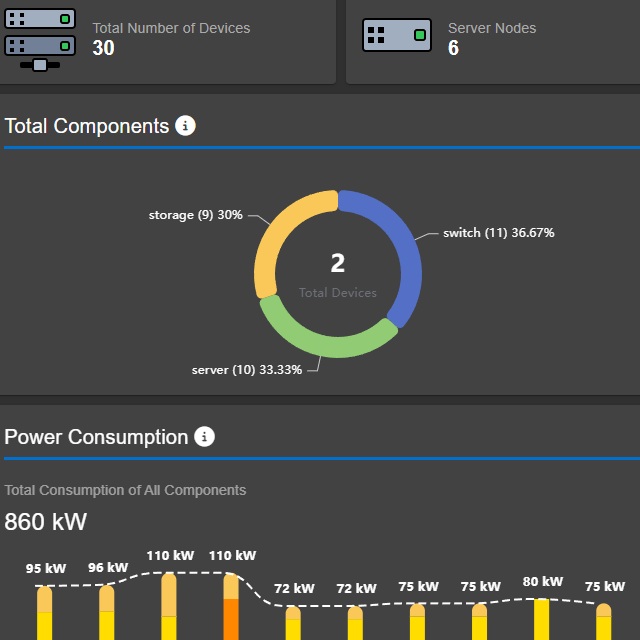
The overview page shows cluster health, GPU utilization, open alerts and month-to-date cost at a glance. The GPU page separates capacity, requested amounts and actual utilization, so queued jobs are never mistaken for idle hardware. Cost showback, which maps spending back to the teams that incurred it, combines compute, storage and token charges into one bill with a subtotal per pricing basis, splits it by team and exports it as CSV for finance.
On the access side, administrators manage roles, account status and multi-factor authentication (MFA) in one place. Creating a user also provisions a dedicated namespace and container registry project, and regular users see only the workspaces they are authorized to use.

Why ASUS: From GPUs to Tokens, with One Accountable Partner
AI projects rarely fail on algorithms; they stall on infrastructure, ownership and cost control. ASUS addresses all three under one roof.
1. Hardware-to-platform continuity: ASUS combines AI server infrastructure with the orchestration layer, so GPU capacity, scheduling and metering are planned together rather than integrated after the fact.
2. Faster time to production: one interface covers environments, pipelines, serving and API access, which shortens the path from first experiment to a live service.
3. Built-in cost transparency: team-level showback and CSV export give finance and IT a shared, auditable view of compute, storage and token spend.
4. Value-added services: requirement assessment and GPU sizing, deployment and integration, administrator and developer onboarding, and ongoing technical support.
5. Partner-ready design: workspaces, quotas, role-based access and per-team billing fit how system integrators and enterprise IT organizations already operate.
Ready to orchestrate AI from GPUs to tokens?
Contact your ASUS representative to arrange a demo and a sizing consultation.
FAQ
1. Can several teams share one GPU?
Yes. A GPU can be allocated in portions, and the platform checks quota and node capacity before each environment starts.
2. How is AI usage charged back to teams?
Each API key is tied to an owner and a workspace. Showback combines compute, storage and token charges into one bill that can be split by team.
3. Does it manage external models too?
Yes. External model services register with the AI gateway alongside in-cluster models and are health-checked continuously.