What is an AI server?
What is an AI Server?
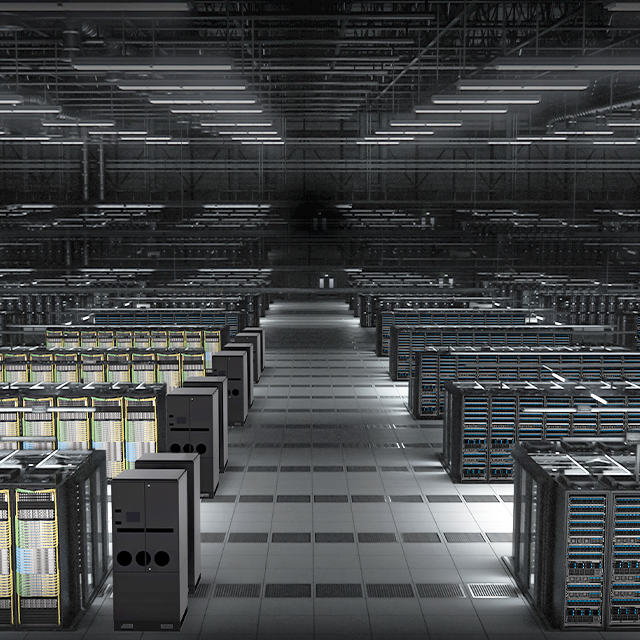
An AI server is a server specifically designed or configured to handle artificial intelligence workloads, combining several components that work together to support the demands of training and running AI models. High-performance CPUs coordinate overall system operation, while GPUs or dedicated AI accelerators, such as those from NVIDIA's Rubin, Blackwell platform or RTX Pro GPU server edition, Intel's Gaudi line, or AMD's Instinct series, provide the parallel processing power that AI algorithms depend on. High-speed memory ensures rapid access to the massive datasets involved in AI processing, while optimized SSD-based storage handles the large training datasets these workloads require. High-bandwidth networking moves data quickly between servers and storage, advanced cooling systems manage the intense heat these components generate under sustained load, and a software stack including frameworks like PyTorch, TensorFlow, and NVIDIA's CUDA platform provides the tools needed to actually build and run AI models on top of the hardware.
While both Workstations and Tower Servers are upright, floor-standing machines, their fundamental design principles and core applications differ significantly. In essence, a workstation is built for demanding individual high-performance computing tasks, whereas a tower server is designed to provide shared resources and services to multiple users across a network.
Why do you need to know it?
General-purpose servers aren't built to feed GPUs or accelerators the volume and speed of data that AI training and inference demand, which means using the wrong platform can leave expensive accelerator hardware idle while it waits on storage or CPU-bound bottlenecks. As AI moves from experimental projects to production systems, powering voice recognition, autonomous vehicles, real-time analytics, and enterprise generative AI, the specific infrastructure requirements of AI workloads have become a practical concern for far more IT teams than just specialized research labs. Understanding what makes a server AI-ready, meaning the balance of compute, memory, storage, and networking, helps organizations avoid costly mismatches between their infrastructure and their actual workload requirements, whether they're training models from scratch or deploying pre-trained models for inference at scale.
Benefits of AI Servers
Purpose-built AI servers dramatically accelerate both model training and inference cycles compared to general-purpose infrastructure, since every major component, from GPUs to storage to networking, is selected specifically to avoid bottlenecking the AI workload. This lets organizations handle massively larger datasets than would otherwise be practical, running simulations, real-time analytics, and inference workloads that general-purpose servers simply can't keep up with. AI servers also scale cleanly, from a single node running inference for a specific application to clusters of interconnected servers training the largest available models, without requiring a fundamentally different architecture at each stage. Because these systems are validated to work well together, with compute, memory, storage, networking, and cooling all balanced for AI workloads specifically, organizations spend less time troubleshooting infrastructure bottlenecks and more time actually developing and deploying AI applications.
How does ASUS help?
ASUS offers AI servers spanning a wide range of scale and processor platforms. The XA-NB3I-E12 pairs dual Intel Xeon 6 processors with eight NVIDIA HGX B300 GPUs for large-scale training workloads, while the ESC8000A-E13 supports AMD EPYC 9006, 9005 or 9004 processors alongside eight dual-slot NVIDIA H200 GPUs, giving customers a choice of processor ecosystem without sacrificing GPU density. Beyond these flagship platforms, the broader ASUS GPU server lineup and its AI POD rack-scale platform extend AI-optimized infrastructure from single-node deployments up to full, pre-validated AI clusters. Every ASUS AI server is engineered with the balanced compute, memory, storage, and networking that AI workloads require, and backed by ASUS-exclusive server-grade reliability features and remote management tools. This range lets organizations start with the AI server platform that matches their current workload, whether that's departmental inference or large-scale model training, and scale up through the ASUS lineup as their AI ambitions grow.