What is Super Intelligence
What is "Super Intelligence" (SI)?
On September 29, 2026, President Donald Trump signed an executive order directing U.S. federal executive departments and agencies to use “Super Intelligence,” or “SI,” in place of “Artificial Intelligence,” or “AI,” in official correspondence, public communications, websites, reports, policy documents, and other non-statutory documents.
The order defines “Super Intelligence” and “SI” for implementation purposes using the existing federal statutory definition of artificial intelligence. It does not require previously issued regulations, contracts, grants, or other historical documents to be changed. The order also calls for proposed legislative language within 60 days to consider establishing a federal definition of the new terminology.
Why do you need to know it?
For now, the change is primarily a terminology and communications directive rather than a fundamental change to the technologies covered by U.S. federal AI law. Existing legal references to artificial intelligence remain in place unless subsequently changed through further executive or legislative action.
The terminology may nevertheless become relevant for organizations that work with the U.S. federal government. Future policy documents, procurement language, grants, and other government communications could incorporate the new terminology as the 60-day review progresses.
Why Is AI Now Being Called “Super Intelligence”?
The White House describes the terminology change as a way to reflect the rapidly advancing capabilities of today’s frontier systems. In its explanation of the executive order, the administration argues that these systems increasingly extend beyond the traditional concept of artificial intelligence by amplifying human capabilities and enabling new applications across areas such as science, medicine, energy, and manufacturing.
At the same time, “superintelligence” already has a specific meaning in AI research, where it is commonly used to describe hypothetical systems whose capabilities exceed those of humans across a broad range of cognitive tasks. As the terminology evolves, organizations may therefore encounter both uses of the term.
How does ASUS help?
Regardless of terminology, the underlying infrastructure requirements remain largely the same. Training and deploying advanced AI systems requires high-density accelerated computing, high-throughput networking, efficient storage, and increasingly sophisticated power and cooling architectures.
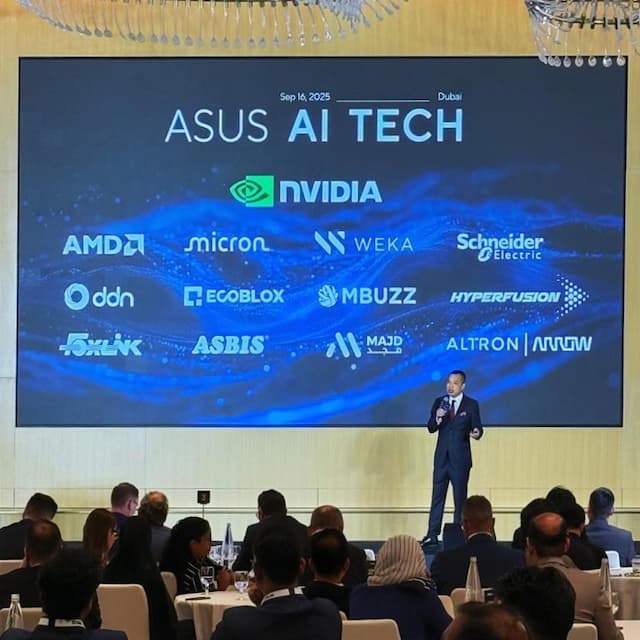
ASUS provides infrastructure across these layers, from GPU servers such as the ESC8000 and XA NB3I series to rack-scale ASUS AI POD platforms based on NVIDIA Vera Rubin Platform or Grace Blackwell architectures, together with high performance storage and integrated software and services. For organizations building advanced AI or “Super Intelligence” environments, the focus remains on the same fundamental infrastructure priorities: compute performance, scalability, power efficiency, cooling, networking, storage throughput, and end-to-end deployment readiness.
As terminology continues to evolve, these infrastructure requirements will remain central to building and operating the next generation of AI systems.