
What is ASUS AI POD?
What is ASUS AI POD?
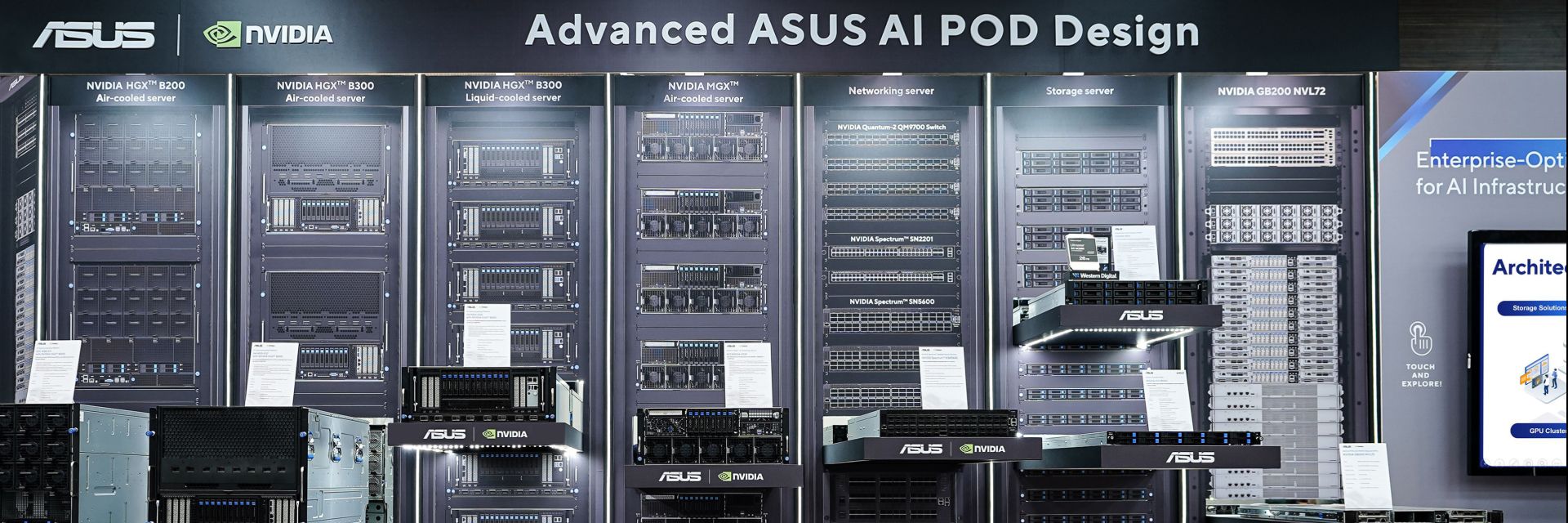
The ASUS AI POD is a scalable, high-performance computing (HPC) system designed for intensive AI workloads, integrating multiple interconnected AI-optimized servers into a unified, powerful cluster. This rack-scale, pre-validated AI infrastructure platform is built around NVIDIA's Vera Rubin and Grace Blackwell architecture, leveraging GPUs, high-speed networking, and specialized software for massive parallel processing. For instance, in its GB300 NVL72 configuration, an ASUS AI POD rack combines 72 NVIDIA Blackwell Ultra GPUs with 36 NVIDIA Grace CPUs, connected through fifth-generation NVLink and up to roughly 40TB of high-speed HBM3e memory. All components function as a single, tightly coupled compute domain, supported by high-speed networking like NVIDIA Quantum-X800 InfiniBand, Spectrum-X Ethernet, and ConnectX-8 SuperNICs. Dedicated liquid-cooling infrastructure and high-capacity power shelves handle the extreme density required, with ASUS delivering the AI POD as a pre-integrated, rack-scale system, engineered and tested as a complete unit from the outset, rather than requiring customers to assemble and validate this complex infrastructure themselves.
Why do you need to know it?
Training and running today's largest AI models, including trillion-parameter language models, complex agentic systems, and inference at massive scale, requires infrastructure with a very different profile than a typical server deployment: dozens of tightly interconnected GPUs, enormous memory bandwidth, specialized networking, and cooling capable of handling extreme power density in a single rack. Assembling this kind of infrastructure from individual components is complex, slow, and risky, since mismatched bandwidth, latency, or cooling capacity anywhere in the chain can bottleneck an entire cluster's performance. Understanding rack-scale AI platforms like AI POD matters because they change the unit of infrastructure decision-making, from selecting individual servers to selecting a validated, complete compute cluster, which affects budgeting, facility planning, and deployment timelines for any organization serious about large-scale AI training, agentic AI or inference.
Benefits of ASUS AI POD
Because ASUS AI POD is pre-validated as a complete rack-scale system, it delivers predictable performance: bandwidth and latency have already been tested and tuned across the entire cluster, rather than left to chance during customer integration. This dramatically simplifies scaling, since organizations can move from a single rack to a multi-rack cluster using proven reference designs rather than re-engineering interconnects and cooling from scratch each time. Deployment is faster as well, since much of the integration complexity that would otherwise consume months of engineering time is handled before the system ever reaches the customer's data center. These efficiencies translate into lower total cost of ownership, since organizations avoid the cost of failed integration attempts, underutilized hardware, or extended time-to-production. AI POD's liquid-cooling design also reduces the environmental impact and power overhead compared to less efficient approaches to cooling extremely dense GPU infrastructure.
How does ASUS help?
ASUS supports AI POD customers across the full deployment lifecycle, not just hardware delivery. This includes architecture design tailored to the customer's specific AI workloads, facility and power planning for the liquid-cooling infrastructure AI POD requires, on-site rack installation, and full system validation before the cluster goes into production. ASUS pairs AI POD compute racks with purpose-built storage, such as the RS501A-E12-RS12U software-defined storage (SDS) server, which is specifically positioned to reduce data latency across the training and inference pipeline, ensuring the GPUs at the heart of the system are never left waiting on data. ASUS has continued to evolve the AI POD platform alongside NVIDIA's roadmap, from the original GB200 NVL72 configuration unveiled at Computex 2024 to the GB300 NVL72 platform announced at GTC 2025 and Vera Rubin NVL72 at GTC 2026, giving customers a clear upgrade path as AI infrastructure requirements grow. This end-to-end approach, spanning architecture, deployment, storage, and validation, is what allows organizations to move from AI ambition to production infrastructure with substantially less risk.
Learn more about ASUS AI POD with advanced reference architecture: ASUS AI Factory for Token Generation