What is AI/HPC Storage
What is an AI/HPC Storage (High Performance Storage)?
AI/HPC storage refers to storage systems specifically engineered to handle the scale, throughput, and access patterns of AI and high-performance computing workloads: large volumes of unstructured data such as images, video, and sensor readings, accessed simultaneously by many GPU-accelerated compute nodes. These systems typically rely on NVMe and NVMe-over-Fabrics technology for low-latency access, parallel file systems that let many nodes read and write concurrently without contention, and techniques like GPUDirect Storage that let GPUs access data directly, bypassing slower traditional data paths. Unlike conventional enterprise storage, which is often optimized for transactional consistency, AI/HPC storage is optimized for sustained, high-volume throughput across continuous pipelines that move data from ingestion, through preprocessing, into training, and finally into inference, all without the storage layer becoming the bottleneck that limits how fast the underlying compute can actually run.
Why do you need to know it?
Expensive GPU-accelerated compute delivers no value if it's sitting idle waiting for data, a problem often called GPU starvation, and one that's more common than many organizations realize. By some industry estimates, only a small fraction of enterprises feel their current infrastructure fully meets their AI needs, and storage is frequently the limiting factor rather than compute capacity itself. As AI training datasets grow into the petabyte range and organizations run continuous pipelines that constantly move data between preprocessing, training, and inference stages, storage that wasn't designed for this pattern becomes an increasingly expensive bottleneck. Understanding AI/HPC storage requirements before deploying AI infrastructure helps organizations avoid a scenario where they've invested heavily in GPU compute, only to see a large share of that investment go underutilized because the storage layer can't keep pace.
Benefits of AI/HPC Storages
Storage designed for AI and HPC workloads sustains the high, consistent throughput that keeps GPU-accelerated compute running at full utilization, rather than idling while waiting on data. Unified access across on-premises, cloud, and edge environments means organizations don't need to physically move or duplicate data before it can be used in training or inference, simplifying pipelines that would otherwise require costly and time-consuming data transfers. These systems are also built to scale simply, adding capacity or throughput as datasets grow without disruptive re-architecture, which matters as AI training datasets continue to expand in size and complexity. Automated data protection features reduce the operational overhead of managing petabyte-scale data manually, letting infrastructure teams focus on supporting AI workloads rather than on storage administration. Together, these characteristics let organizations maximize the return on their GPU investment by ensuring storage never becomes the limiting factor.
How does ASUS help?
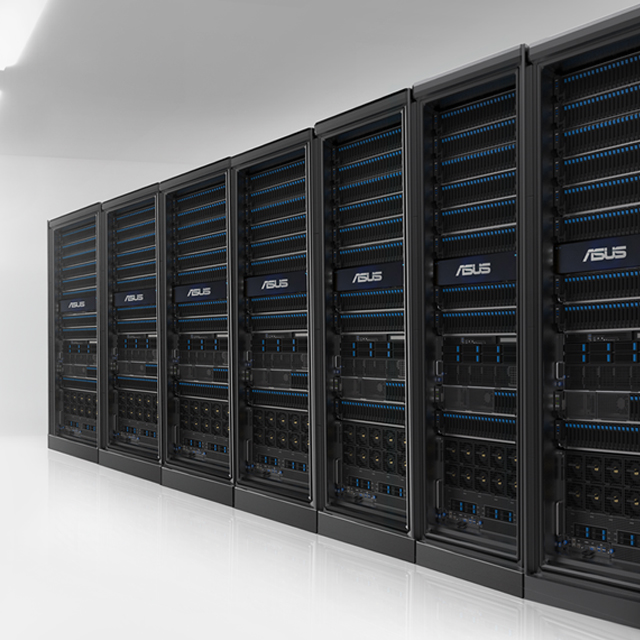
ASUS addresses AI/HPC storage needs primarily through the UF920-E3-RS24, empowering by NVIDIA Vera CPU with NVIDIA BlueField-4 DPU and ConnectX-9 SuperNIC technology as well as the RS501A-E12-RS12U, a compute-and-software-defined-storage platform purpose-built for demanding AI computing environments. The system delivers file, object, and block storage simultaneously through software-defined storage, supporting all-flash configurations and flexible tiering and backup strategies rather than the fixed interfaces of legacy storage systems. ASUS specifically pairs this platform with its AI POD rack-scale AI infrastructure, positioning it to reduce data latency across the training and inference pipeline so that the dozens of GPUs in an AI POD deployment are never left waiting on data. ASUS has continued to expand this storage portfolio at major HPC and AI industry events, including new storage-server solutions presented at SC24 and expanded offerings shown at SC25 and SC26, reflecting the pace at which AI storage requirements are evolving. For organizations building AI infrastructure, this means ASUS can deliver compute and storage as a coordinated system rather than components that need to be separately sourced and validated.